
The Falling Action
A sequel to "An Introduction", "The Rising Action" and "The Climax"

Hey everyone! For today’s article, we will be taking a deeper look at the “Falling Action” of a story.
Firstly, if you have not already done so, check out the first and second articles in the series, “An Introduction”, “The Rising Action” and “The Climax” by clicking on the buttons below.
Now, without further ado, let’s jump right into it!
Recap
Essentially, throughout this article, whenever the word “writing” is mentioned, it refers to “Story writing”.
Story writing refers to the method of writing in which the writer narrates a series of events that has led to a problem, the progression of the same and the end result that has led to the current situation of the characters in the story.
In a typical piece of writing/ essay, there are (at least, but not limited to) 5 essential parts, namely:
-Introduction
-Rising action
-Climax
-Falling action/ Resolution
-Conclusion
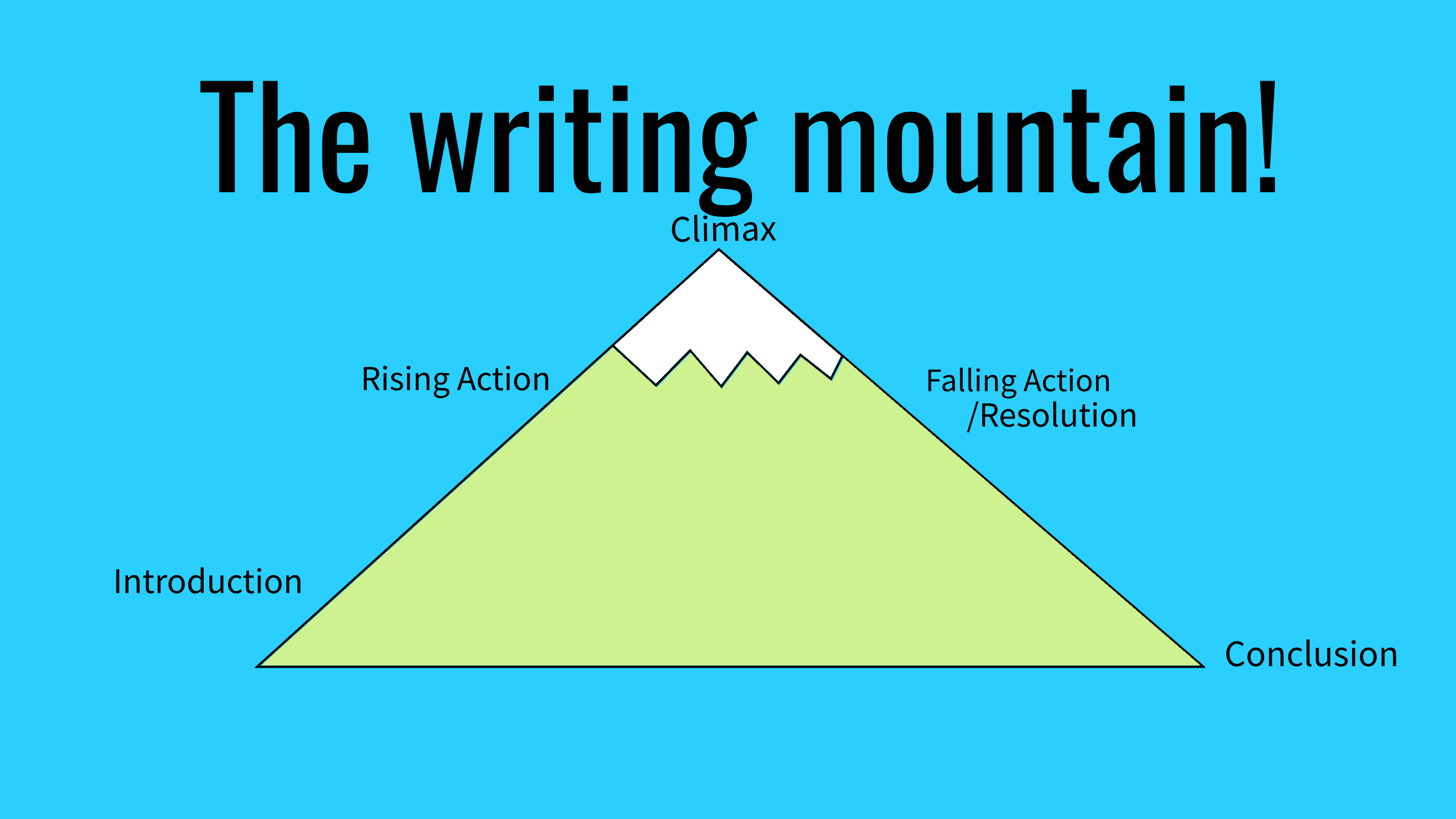
You can think of the five parts as a “mountain”, where you start from the base of the mountain, and work your way up, until the climax, which is like the “peak”. From there, you will work your way down, all the way until the conclusion, where you will reach the base again.
For this article, we will be focusing on the falling action.
What is the Falling Action?
Falling action is the period of time in a story that follows the climax and leads to the resolution. It can be used to clarify the events of the climax, ease any built-up tension, or wrap up loose ends (if there have been lingering questions in the plot). It is also usually the time when the resolution happens (which is why the two terms are used interchangeably), but remember, that like any of the other parts, this need not be the case—in fact, the falling action is just loosely described as the part after the climax.
Personally, I like to think of the falling action as the gradual stop of the rollercoaster in the analogy raised in “The Climax”. It is like the point where the suspense is slowly dying down, you are recovering from the adrenaline rush you just received, and the screams of terrified people are dying down.
Why is falling action important?
Authors use falling action for several different purposes. Although falling action may be a small part of the overall narrative, it's a very important transition between the climax and the resolution. The following sections will discuss three primary purposes of falling action.
Even in the shortest stories, rarely does the climax immediately lead to the ending. That is what we call an “abrupt end”, and is rarely seen. There is almost always some sort of transition that moves the plot and the characters toward the conclusion.
One of the main purposes of falling action is to move the plot towards the final resolution and allow a smooth transition between the dramatic heights of the climax and the landing of the resolution. That way, it is not like a cliffhanger, immediately leaving the audience in the dusk, not knowing what to expect/ make sense of the story.
Crafting Your Story's Falling Action Using 5W1H
To develop the falling action—the section where tensions begin to resolve after the climax—the 5W1H method remains valuable.
Again, if you have not read the previous articles, you can refer to it for a better understanding of the method. In essence, however, throughout the writing, we will use the 5W1H questions to craft “prompts”, to give us an idea on what the general direction of the story will be.
5W1H stands for Who, What, Where, When, Why and How. It is a framework used to gather and organise information in our writing. Here are some examples of the prompts we can craft with the 5W1H questions:
WHO: Who deals with the aftermath and consequences of the climactic confrontation?
WHAT: What changes or resolutions occur as a result of the climactic events?
WHEN: When do characters begin to process what happened and adjust to the new reality?
WHERE: Where do characters find themselves physically and emotionally after the storm has passed?
WHY: Why does your protagonist's world view or relationships transform following the climax?
HOW: How do characters begin reconciling with the new status quo or healing from their ordeal?
Of course, these are just prompts which you could use to whip up a basic falling action; in fact, there are many other ways to continue a falling action, and the prompts are certainly not fixed and universal for every story, but for now, we will be sticking to these questions. All the prompts may not apply to the falling action as well; in fact, some of them will become more useful for previous and other parts of the writing.
Here is an example, using the prompts to craft an rising action: Suppose that I want to write a story about “An Act of Kindness”, involving two characters: Amy, who is the on the receiving end of the act of kindness, and Bob, who is displaying kindness towards Amy. The incident happened in school, during Lunch break. Here is the continuation from the last three articles, with my comments and insights using the 5W1H prompts:
(Do take note that it is an adaptation of ChatGPT.)
WHO: Bob and Amy must both navigate the social aftermath of the confrontation, while Jake faces the consequences of his exposed bullying.
WHAT: The power dynamic in the school shifts as other students begin to acknowledge the harmful culture they've enabled. Small acts of kindness toward Amy emerge from unexpected sources.
WHEN: The following days reveal the lasting impact of Bob's stand, as the initial shock gives way to reflection among the student body.
WHERE: In the same hallways and cafeteria that once felt threatening to Amy, new possibilities for connection and belonging begin to take root.
WHY: Bob's perspective on popularity and courage permanently changes as he recognizes the value of standing up for what's right over maintaining social comfort.
HOW: Amy gradually rebuilds trust in her peers while Bob learns to use his social influence positively rather than remaining a passive bystander.
So, with these prompts in mind, the falling action could look like this:
The cafeteria had fallen silent after Bob's confrontation with Jake. Even as the bell rang signaling the end of lunch period, the tension lingered in the air. Amy stood frozen, her eyes wide with disbelief at what had just happened.

"You didn't have to do that," she whispered as they gathered their things.

"Yes, I did," Bob replied, his heart still racing. He noticed several students glancing their way—not with mockery this time, but with something that looked almost like respect.

The next morning, Bob approached his usual lunch table with uncertainty. The conversation stopped abruptly when he arrived. Mark, another friend from the group, slid over to make room.

"That was pretty intense yesterday," Mark said, breaking the awkward silence.

Bob set his tray down carefully. "Someone needed to say something."

"Jake's been suspended," Sarah added quietly. "Principal called his parents in after they found all those messages on his phone."

Bob nodded, surprised by the swift consequences but relieved that the school had taken action. Across the cafeteria, he spotted Amy sitting alone again. Without hesitation, he picked up his tray.

"I'm going to sit with Amy today," he announced. He expected resistance or ridicule, but instead, Mark stood up too.

"Mind if I join you?" Mark asked. "I should have said something sooner."

As they crossed the cafeteria, Bob noticed Amy's surprise when she saw them approaching. The fear in her eyes was still there, but something else flickered alongside it—a cautious hope. When she smiled hesitantly at them, Bob realized that sometimes courage was contagious.

Over the next few days, other students began to acknowledge Amy in the hallways. The anonymous notes stopped completely. In their English class, Lisa—who had always been quiet but watched everything—asked Amy if she wanted to partner for the upcoming project.

"Things are different now," Amy told Bob as they walked home one afternoon. "Not perfect, but different."

Bob understood what she meant. The school hadn't transformed overnight, but small shifts were happening. He'd seen Jake in the hallway that morning, returning from his suspension. Their eyes had met briefly before Jake looked away, something like shame crossing his face.

"I think we all learned something," Bob replied, realizing how much his own perspective had changed. The cost of standing up had been real—some of his friends still kept their distance—but the weight he'd carried from staying silent had been heavier than he'd realized.
Conclusion
In conclusion, by using the 5W1H questions, we can:
Effectively craft prompts, which can be used to give us cues on what to curate throughout our story;
Use it to craft a good/ complete falling action (Which helps us in the development of the conclusion, and give a suitable ending to our story).
If you have any suggestions, feel free to leave it in the comments!
If not, until next time, see you in the next article!
(P.S. Sorry for not uploading recently. Have a huge project coming up, for Substack! Stay tuned.)